The Evolution of the Customer Journey — and What It Means for Your Business
Updated: April 16, 2026
Published: October 24, 2025
Understanding how the customer journey has evolved is the first step toward staying relevant in a world that doesn’t stop moving.
There was a time when the company controlled everything.
You decided what customers knew, when they knew it, and how they heard it. Your sales team was the gatekeeper of knowledge, and your marketing materials lived in folders and trade show booths.
Those days are gone.
Today, the customer controls the journey, and the pace of change is faster than most businesses can keep up with. Understanding how the customer journey has evolved is the first step toward staying relevant in a world that doesn’t stop moving.
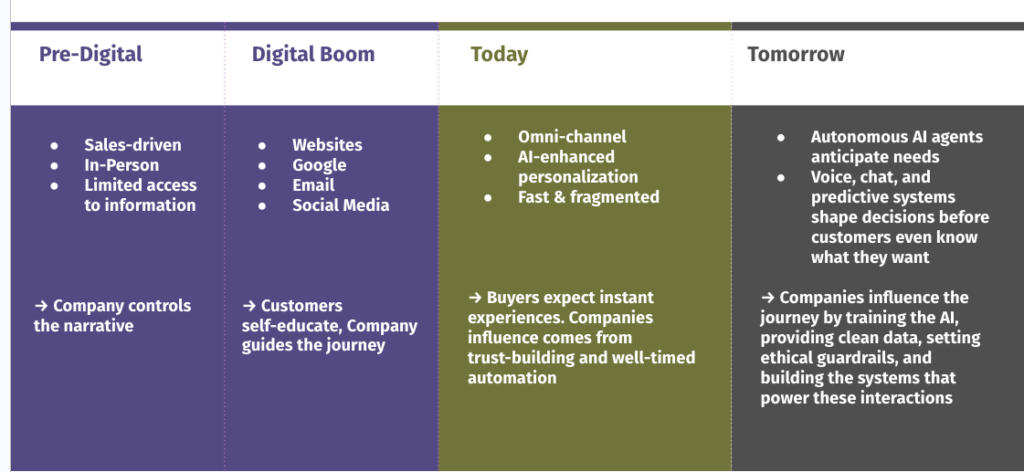
The Pre-Digital Era — The Company Was in Control
Before digital technology, the path to purchase was short and simple. Buyers relied on sales reps, printed brochures, and word of mouth.
- The company dictated the flow of information
- Sales was personal and relationship-driven
- Marketing focused on visibility and reputation
The entire journey revolved around the seller. The buyer was largely reactive, limited by what information the company provided. It worked because there were fewer choices and slower competition.
The Digital Boom — The Buyer Takes the Wheel
When the internet arrived, everything changed. Search engines, websites, and email shifted the balance of power from the company to the customer.
Suddenly, buyers could:
- Research products long before contacting a salesperson
- Compare competitors instantly
- Read reviews and seek out social proof
- Learn independently and form opinions before you ever knew they existed
The customer became self-sufficient. The role of marketing evolved from telling people what you do to helping them discover how you solve their problem.
The winners were those who embraced content marketing, SEO, and early automation. The laggards kept talking about themselves — and lost attention.
Today — Omni-Channel, Fast, and Fragmented
Today’s journey is everywhere and happening all the time.
Buyers move seamlessly between Google, social platforms, ads, podcasts, emails, and peer recommendations. They expect information to be instant, consistent, and relevant wherever they find you.
Your website, your social posts, your chatbot, and even your sales team need to work in sync to create one connected experience.
What makes this tricky is that your buyer’s attention is fragmented. They are constantly scrolling, switching platforms, and comparing options. That means your job is no longer to “reach” them. It’s to be available and valuable whenever they reach you.
This requires connected data, unified systems, and AI tools that adapt to customer behavior in real time.
Tomorrow — AI Agents Lead the Journey
The next evolution is already unfolding. Artificial intelligence is fundamentally changing how customers discover, evaluate, and buy.
AI agents will:
- Anticipate needs based on user data and preferences
- Make proactive recommendations or complete purchases
- Deliver hyper-personalized experiences at scale
- Engage across voice, chat, and predictive systems
This doesn’t mean human marketers and salespeople disappear. It means your role shifts.
Your responsibility becomes training and guiding the AI, defining your brand’s voice and ethics, and designing the experience your AI systems deliver.
Companies that get this right will gain massive efficiency and customer loyalty. Those that ignore it will lose relevance as AI-powered competitors deliver faster, smarter, and more intuitive interactions.
What This Means for Your Business
This isn’t just a marketing conversation. It’s a business transformation conversation.
The customer journey now touches every department: from marketing and sales to operations and support. Every team needs to understand how automation, data, and personalization work together to create value for the customer.
Here’s the reality:
- If your website still talks about you instead of your customer, you’re losing trust.
- If your data lives in silos, you’re wasting insights.
- If your marketing reacts instead of predicts, you’re behind your competitors.
AI isn’t about replacing people. It’s about empowering them with data-driven tools that make every customer interaction more relevant and impactful.
It’s Time to Adapt!
Your customers have evolved. Their journey has evolved.
If your marketing, website, or operations haven’t kept pace, now is the time to act.
Start by mapping your current customer journey. Identify where people are dropping off, what questions they can’t find answers to, and which steps feel clunky or slow.
Then, explore where AI can help:
- Automate manual processes
- Personalize the user experience
- Predict what customers need next
The businesses that win in the next decade will be those that adapt faster and align their strategy with the way people actually buy today.
Keystone Click’s Guide to Profits
As a business owner or marketing executive, you are faced with the challenge of bringing in new prospects and converting them into customers. Our free downloadable, Guide to Profits, gives you tips and tricks to build brand awareness, generate leads, and nurture those opportunities.
View Recent Resources

Lori Highby
Our founder and truly fearless leader, Lori Highby! Her brain is teeming with winning game plans for our clients’ business growth. With a passion for team-building, a dedication to education, and years of experience in the field, you’re sure to score with her big brain on your side.