Why Website Speed Matters More in the Age of Google AI Search
Updated: September 6, 2026
Published: June 1, 2026
Many companies blame weak SEO performance on content, keywords, or competition when the real issue may be technical performance. If your website is slow, unstable, or poorly maintained, even strong content can struggle to rank, convert, or appear in AI-powered search experiences. In today’s search environment, website speed is no longer a behind-the-scenes issue. It's a hidden SEO factor that can quietly limit visibility, trust, and lead generation.
Businesses invest heavily in SEO content, keyword research, paid campaigns, and social media. But one of the most important visibility factors is often overlooked: the infrastructure behind the website.
As search becomes more AI-powered, website performance matters more than ever. Google’s AI Overviews and other AI-driven search experiences rely on content that’s accessible, crawlable, trustworthy, and useful. A slow or poorly maintained website can weaken visibility before a prospect ever reaches the page.
Website speed now affects more than user experience. It influences SEO visibility, AI search visibility, user trust, lead generation, and conversion performance. Google recommends strong Core Web Vitals because they measure real-world user experience across loading speed, interactivity, and visual stability.
Fast, well-supported websites are no longer optional. They are foundational to digital visibility and business growth.
Keystone Click approaches hosting, website care, and WordPress support as part of a broader marketing strategy because your website is not just a technical asset. It’s one of the most important engines behind discoverability, credibility, and lead generation.
The Website Performance Chain: How Hosting Impacts Lead Generation
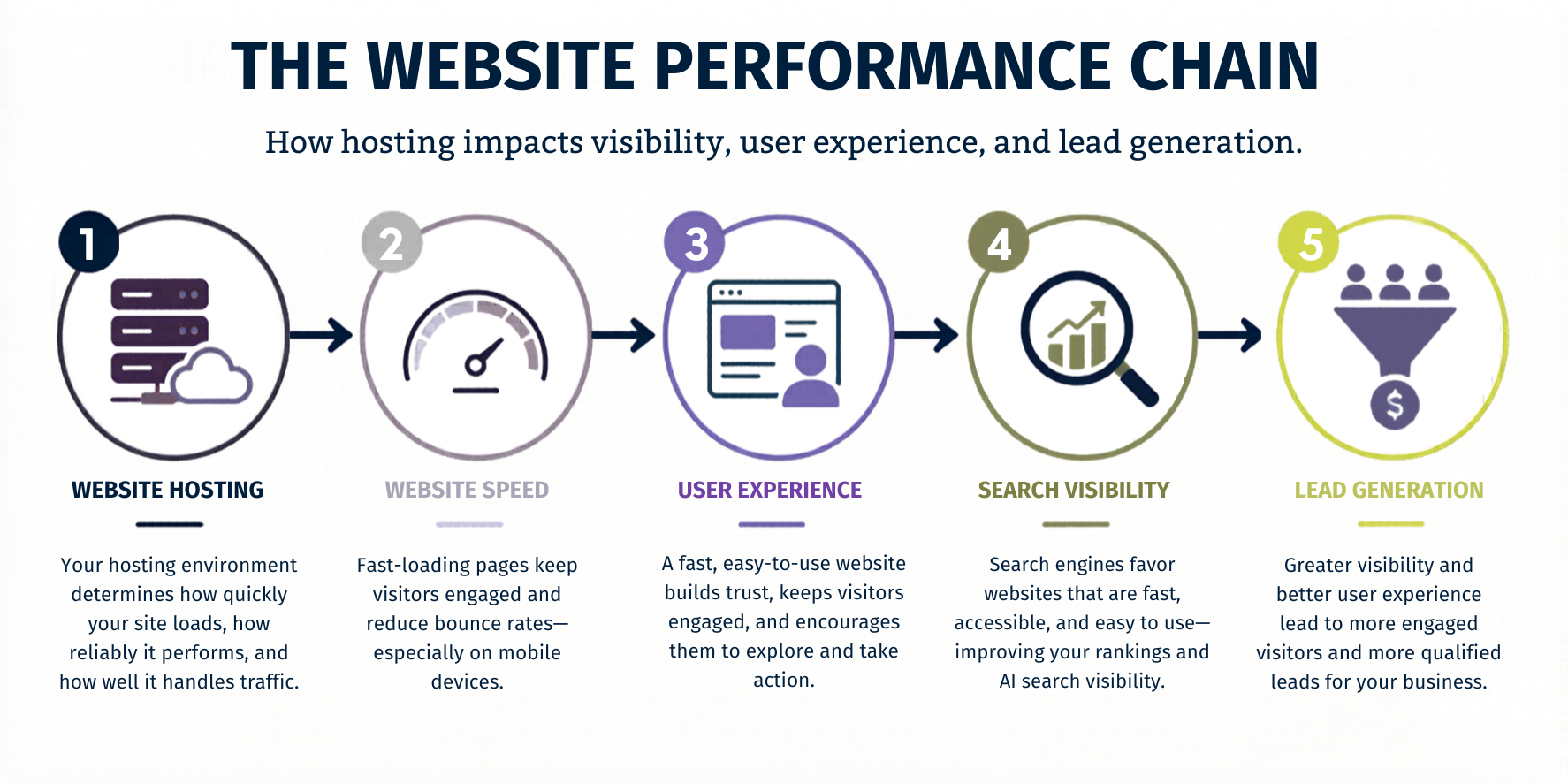
Website hosting may seem like a technical detail, but it directly affects how well your website supports marketing and sales. When hosting is slow, unstable, or poorly supported, it can create a chain reaction that weakens visibility and reduces leads.
Website Hosting → Website Speed → User Experience → Search Visibility → Lead Generation
Here’s how that chain works:
Website hosting affects website speed
Your hosting environment determines how quickly your pages load, how reliably your site performs, and how well it handles traffic.
Website speed affects user experience
When pages load slowly, visitors are more likely to leave, especially on mobile devices. A fast site makes it easier for users to explore your content, trust your brand, and take action.
User experience affects search visibility
Search engines look for websites that are helpful, accessible, and easy to use. If your site is slow or frustrating, it can weaken the performance of your SEO content.
Search visibility affects lead generation
When your website is easier to find and easier to use, more qualified prospects can discover your business, engage with your content, and convert into leads.
Why Website Speed Impacts More Than User Experience
Website speed shapes the first impression a visitor has of your business. Before they read your headline, explore your services, or submit a contact form, they experience how your website performs.
A fast website feels professional, reliable, and easy to use. A slow website creates friction. It can make visitors wonder whether the business behind it is just as outdated, disorganized, or difficult to work with.
That perception matters, especially on mobile devices. Buyers expect pages to load quickly and function smoothly. When they do not, users are more likely to leave before engaging with the content. And when users leave before a page fully loads, businesses lose more than traffic. They lose the opportunity to build trust, answer a buyer’s questions, generate leads, and move prospects further into the buying journey. Cloudflare notes that website speed affects user experience, SEO, conversion rates, and revenue.
For businesses that rely on their website to generate leads, every delay creates risk. A slow site can reduce form submissions, phone calls, appointment requests, downloads, and other conversion actions. It can also weaken the return on every marketing channel, driving traffic to the site, from SEO and paid search to email and social media.
A slow website does not just frustrate users. It quietly reduces visibility and revenue opportunities.
How Website Speed Affects SEO and AI Visibility
Google Prioritizes Fast, User-Friendly Websites
Google’s Core Web Vitals measure key parts of the page experience, including loading performance, responsiveness, and visual stability. The current Core Web Vitals metrics include Largest Contentful Paint, Interaction to Next Paint, and Cumulative Layout Shift.
These metrics help Google understand whether users are likely to have a positive experience on a page. While Core Web Vitals alone do not guarantee top rankings, Google states that they are used by its ranking systems and recommends achieving good scores for Search success.
That means website speed and SEO are connected. A business can publish helpful, well-optimized content, but if the website is slow, unstable, or difficult to use, that content may not perform as well as it could.
Speed also has a direct impact on user behavior. Google has reported that 53% of mobile site visitors leave a page that takes longer than three seconds to load. That means a slow website can lose potential buyers before they ever read your message, explore your services, or submit a form.
AI Search Experiences Favor Trusted, Accessible Websites
AI-powered search does not replace the need for SEO. Google’s guidance for generative AI search says SEO best practices continue to matter because AI features in Google Search are rooted in Google’s core ranking and quality systems. Google also explains that its generative AI features use publicly accessible, crawlable content from the Search index to help provide relevant, grounded responses.
Put simply, AI search systems need to be able to find your content, access your pages, understand the structure, and evaluate whether the experience is useful. Fast-loading, technically healthy websites make that process easier. Slow, unstable, or poorly maintained websites create friction for both users and search systems.
This makes technical performance even more important. If your website has poor crawlability, slow performance, inaccessible design, broken pages, or weak structure, it may be harder for both search engines and AI systems to understand and surface your brand.
AI search visibility makes sure your content is supported by a fast, accessible, well-maintained website that search engines and AI systems can trust.
Slow Websites Hurt Engagement Signals
When visitors land on a slow page, they are less likely to stay. They may bounce back to search results, visit a competitor, or abandon the buying journey altogether.
That behavior affects more than a single session. Lower engagement can weaken the performance of your SEO content over time. If users do not stay long enough to read, click, convert, or explore additional pages, your website is missing opportunities to prove relevance and value.
If your website feels slow to visitors, search engines and AI systems notice too.
What Actually Slows Down a WordPress Website?
Website performance problems are rarely caused by one issue. More often, they build up over time as a business grows, adds new tools, publishes more content, changes vendors, or delays website maintenance.
The challenge is that many of these issues happen behind the scenes. Business owners may not see the technical problem, but they do see the results: fewer leads, lower engagement, frustrated visitors, weaker SEO performance, and a website that no longer supports growth the way it should.
Outdated or Low-Quality Hosting
Hosting is the foundation of website performance. If that foundation is weak, everything built on top of it can suffer.
Low-quality hosting can make pages load slowly, create inconsistent performance, or cause downtime during important moments. For a business, that means prospects may leave before they see your services, fill out a form, or schedule a consultation.
The business cost: poor hosting can make your company look less reliable, reduce trust with first-time visitors, and limit the return on your SEO, paid ads, and content marketing.
Poor Plugin Management
Plugins can help a WordPress website do more, from adding forms and popups to improving design, tracking, search features, and integrations. But businesses often add plugins over time without realizing each one can affect speed, stability, and even lead generation performance.
Too many plugins, outdated plugins, or poorly built plugins can slow the site down or cause parts of the website to break. That can create problems visitors notice, such as forms not loading, pages freezing, buttons not working, or mobile layouts feeling clunky.
The business cost: plugin issues can interrupt the buyer journey. If a form does not work, a page loads too slowly, or a visitor gets frustrated, the business may lose a lead without ever knowing it.
Lack of Caching or CDN Configuration
Caching and CDN setup may sound technical, but the business impact is simple: they help your website load faster for more people, in more places, on more devices.
Without them, visitors may experience unnecessary delays, especially if they are browsing on mobile, using a slower connection, or located farther from your website’s server. Even a well-designed website can feel sluggish if it’s not configured to deliver content efficiently.
The business cost: slower load times can reduce engagement, increase bounce rates, and weaken the performance of every marketing channel sending traffic to your site. If you are paying for ads or investing in SEO, poor speed can make that traffic less valuable.
Large Images and Unoptimized Media
Images, videos, and graphics help tell your story, but oversized media can quietly slow down the entire website.
This often happens when teams upload high-resolution photos, large graphics, or embedded videos without optimizing them for web performance. The website may still look good, but visitors may have to wait longer for pages to load.
The business cost: unoptimized media can create friction at the exact moment a visitor is deciding whether to stay, trust your brand, and take action. A beautiful website that loads too slowly can still lose leads.
Neglected Website Maintenance
Websites need ongoing care to stay fast, secure, and reliable. Over time, WordPress core files, themes, plugins, security settings, backups, and performance tools need to be reviewed and updated.
When maintenance is ignored, small issues can build into bigger problems. Pages may slow down, forms may stop working, security risks may increase, and the site may become harder to manage.
The business cost: neglected maintenance can lead to downtime, lost leads, lower trust, and emergency fixes that cost more than proactive support. It can also make the website less dependable as a marketing and sales tool.
The Bigger Business Problem
Most website speed issues are not just technical problems. They are growth problems.
A slow WordPress website can make strong marketing look weaker than it really is. It can cause SEO content to underperform, paid traffic to convert poorly, and potential customers to leave before they ever understand your value.
For business owners, the real question is not just, “What is slowing down the website?” It is, “How much visibility, trust, and revenue are we losing because of it?”
Why Managed WordPress Hosting Matters
For many growing businesses, managed hosting is less about outsourcing technical tasks and more about protecting the visibility and lead-generation systems the business depends on.
Your website is not just a digital brochure. It’s where prospects discover your brand, evaluate your credibility, engage with your content, and decide whether to take the next step. If that website is slow, unstable, vulnerable, or unsupported, your marketing performance is at risk.
Managed WordPress hosting provides strategic operational support for one of your most important growth assets. Instead of reacting when something breaks, a proactive website partner helps keep your site fast, secure, updated, and ready to support SEO, AI search visibility, and conversions.
Keystone Click’s website services include managed WordPress hosting optimized for performance, security, daily backups, plugin compatibility oversight, staging environments, and ongoing technical monitoring. But the real value goes beyond maintenance. It’s performance stewardship: making sure your website continues to support visibility, trust, and lead generation as your business grows.
Proactive Partnership
Managed hosting gives your business a partner who is actively watching the health of your website, not just stepping in when there is a problem.
That matters because website issues often build quietly. A plugin update, a slow-loading page, a broken form, or a security vulnerability can affect performance before your team notices. With proactive support, these risks can be identified and addressed before they disrupt users or damage marketing results.
The business value: your website has ongoing strategic oversight, so your team can stay focused on growth instead of troubleshooting technical problems.
Marketing Protection
Every marketing channel eventually points back to your website. SEO, paid ads, email campaigns, social media, referrals, and AI search visibility all depend on a website that works when prospects arrive.
If your site is slow or unreliable, your marketing investment becomes less efficient. You may still be generating traffic, but fewer visitors may stay, engage, or convert.
The business value: managed WordPress hosting helps protect the performance of the campaigns, content, and visibility efforts you are already investing in.
Performance Stewardship
Website performance is not a one-time project. It needs ongoing attention as your site grows, new content is published, plugins are added, traffic changes, and search expectations evolve.
Managed hosting supports continuous performance stewardship by monitoring the factors that affect speed, uptime, security, and usability. This helps your website remain a strong foundation for SEO performance, AI search visibility, and user trust.
The business value: your website is not just maintained. It’s actively supported as a business asset that needs to perform over time.
Reduced Internal Burden
Without managed support, website issues often fall on internal teams that may not have the time, tools, or technical expertise to solve them quickly.
That can lead to delayed updates, unresolved performance issues, broken functionality, or costly emergency fixes. It can also pull marketing and leadership teams away from strategy, sales, and customer experience.
The business value: managed hosting reduces the internal burden of keeping the website fast, secure, and reliable, so your team can focus on the work that drives the business forward.
Stronger Website Reliability
A reliable website builds trust. Visitors expect pages to load, forms to work, and information to be accessible whenever they need it.
Managed hosting helps reduce the risk of downtime, broken pages, security interruptions, and performance issues that can damage the user experience.
The business value: a reliable website gives prospects confidence in your brand and makes it easier for them to take action.
Better Visibility Readiness
Search engines and AI-powered search experiences depend on websites that are crawlable, accessible, and technically healthy.
Managed WordPress hosting helps support the technical foundation behind digital visibility. When your website is fast, secure, structured, and well-maintained, your content has a stronger chance of being discovered, understood, and trusted.
The business value: managed hosting helps your website stay ready for the visibility opportunities your business is trying to earn.
Managed hosting is not just website maintenance. It’s strategic support for marketing performance, brand trust, digital visibility, and lead generation.
The Business Impact of Better Website Performance
Website speed affects real business outcomes because nearly every digital marketing effort depends on what happens after someone lands on your site.
A faster, better-supported website can lead to:
- Better SEO visibility
- Increased AI search discoverability
- Stronger organic engagement
- Higher PPC efficiency
- Improved mobile conversion rates
- Reduced abandoned sessions
- More qualified leads
- Better long-term return from content marketing
When your website loads quickly and functions smoothly, visitors are more likely to stay, read, click, and convert. That improves the value of every channel sending traffic to your site, from Google Search and AI-powered search experiences to paid ads, email campaigns, social media, and referrals.
For example, if your business is paying for PPC traffic, a slow landing page can waste budget by causing users to leave before they take action. If your business is investing in SEO content, poor site performance can reduce engagement and limit the return on that content. If most of your visitors are on mobile, even a few extra seconds of load time can create enough friction for a prospect to abandon the session and choose a competitor instead.
Now imagine two businesses invest the same amount in SEO content. Both publish helpful blogs, detailed service pages, and educational resources. Both target relevant keywords. Both understand their audience. Both are trying to earn visibility in traditional Google results and AI-powered search experiences.
But one business has a fast, stable, well-supported website. Its pages load quickly. Its forms work. Its mobile experience feels smooth. Its content is easy to access, crawl, and engage with.
The other business has a slower, outdated website. Pages lag. Plugins occasionally break. Mobile users experience friction. Some visitors leave before the site fully loads. Others hesitate because the experience feels clunky or unreliable.
Over time, that difference compounds.
The faster website is more likely to keep visitors engaged, support stronger organic performance, improve paid campaign efficiency, increase mobile conversions, and turn more traffic into qualified leads. The slower website may still have strong content, but performance issues limit how much value that content can generate.
That’s the hidden business cost of slow website speed: it makes every marketing investment work harder for weaker results.
Website performance optimization should not be treated as a back-end task. It’s part of the marketing strategy, because speed, stability, and support directly influence whether your visibility turns into revenue.
Your Website Infrastructure Is Part of Your Marketing Strategy
Hosting affects discoverability. Discoverability affects lead generation. Website support affects brand trust.
That means infrastructure and marketing are no longer separate conversations.
For years, many businesses treated website infrastructure as a technical concern and marketing as a visibility concern. But in today’s search environment, those two areas are deeply connected. Your hosting, site speed, uptime, accessibility, security, and maintenance all influence how easily people, search engines, and AI systems can find, understand, and trust your content.
Your website is often the first place prospects interact with your brand. It’s also where search engines and AI systems evaluate your relevance, authority, accessibility, usefulness, and technical trust signals. If your website is slow, unstable, difficult to crawl, or poorly maintained, your content may have a weaker foundation before the visitor or search engine ever evaluates the message itself.
This matters even more as visibility ecosystems become more complex. Businesses are no longer optimizing only for traditional Google rankings. They are also competing for visibility in AI Overviews, AI-powered search results, answer engines, local search, organic listings, paid search, and referral-driven discovery. Across all of these channels, your website needs to be technically healthy enough to support the visibility you are trying to earn.
A high-performing website gives your content a stronger foundation. It helps users move through the buyer journey with less friction. It helps search engines crawl and evaluate your pages more effectively. It improves AI-readiness by making your content easier to access, structure, interpret, and trust.
That’s the a-ha moment: website infrastructure is not behind the marketing strategy. It’s underneath it.
When the infrastructure is weak, the entire visibility system becomes weaker. SEO content may underperform. Paid traffic may convert poorly. AI systems may struggle to understand your pages. Prospects may leave before they trust your brand. But when the infrastructure is strong, every marketing effort has a better chance to work.
Keystone Click positions website care and support as ongoing performance stewardship, not just emergency fixes. Their Website Care & Support service focuses on keeping sites secure, stable, fast, updated, and ready to support growth.
That’s the difference between simply having a website and having a website that actively supports your business goals.
Related Resources from Keystone Click
Explore these related resources to strengthen your website performance, SEO, and AI visibility strategy:
- Learn more about managed WordPress hosting and ongoing support through Keystone Click’s Website Care & Support services.
- Explore Keystone Click’s AI & SEO services for improving visibility across Google and AI-driven search platforms.
- Review Keystone Click’s website optimization and development services for building a stronger foundation for growth, trust, SEO, and AI visibility.
- Learn how Keystone Click approaches AI visibility strategy through the AI Alignment Model.
FAQ: Website Hosting and SEO
Does website hosting affect SEO?
Yes. Website hosting affects speed, uptime, security, and user experience, all of which can influence SEO performance. A fast, stable hosting environment helps search engines crawl your site more efficiently and helps users engage with your content.
Does website speed impact Google AI search visibility?
Yes. Website speed can indirectly impact Google AI search visibility because AI-powered search experiences rely on content that’s accessible, crawlable, and aligned with Google’s broader search quality systems. Google states that SEO best practices continue to matter for generative AI features in Search.
Can hosting affect Google AI Overviews?
Yes. Hosting can indirectly affect visibility in Google AI Overviews because it influences how fast, stable, accessible, and crawlable your website is. AI-powered search experiences depend on content that search systems can discover, understand, and trust. A fast, technically healthy website gives your content a stronger foundation for both traditional SEO and AI-powered search visibility.
What is managed WordPress hosting?
Managed WordPress hosting is hosting designed specifically for WordPress websites. It typically includes proactive updates, monitoring, backups, performance optimization, security support, and experienced technical assistance.
Can slow websites hurt conversion rates?
Absolutely. Slow websites can increase abandonment, reduce trust, and prevent visitors from taking action. Cloudflare notes that website speed affects conversion rate, SEO, traffic, and revenue.
How fast should a business website load?
A business website should load as quickly as possible, with a strong goal of loading key content within two to three seconds, especially on mobile devices. The faster and smoother the experience, the easier it is for users to engage and convert.
Website Performance Is No Longer Optional
Website speed affects far more than convenience. It influences how users experience your brand, how search engines evaluate your pages, and how AI-powered search systems understand and surface your content.
As Google Search continues to evolve with AI Overviews and other AI-driven experiences, businesses need websites that are fast, accessible, well-maintained, and technically sound. Strong content still matters, but content performs best when it’s supported by reliable infrastructure.
Hosting quality, WordPress maintenance, website speed, security, and uptime all play a role in digital visibility. They affect whether prospects find you, trust you, and take the next step.
Businesses can no longer separate website infrastructure from marketing performance. A slow website can limit the impact of your SEO, weaken AI search visibility, and reduce lead generation opportunities.
To strengthen the foundation behind your digital growth, explore Keystone Click’s Website Care & Support services and learn how proactive website support can help protect your visibility, trust, and conversions.
Partner with Keystone Click
Businesses can no longer separate website infrastructure from marketing performance. A slow, unsupported website can limit SEO results, weaken AI search visibility, and reduce the number of leads your marketing is able to generate.
Learn more about Keystone Click’s Website Care & Support services and discover how proactive website support can help protect your speed, visibility, trust, and conversions.
Keystone Click’s Guide to Profits

As a business owner or marketing executive, you are faced with the challenge of bringing in new prospects and converting them into customers. Our free downloadable, Guide to Profits, gives you tips and tricks to build brand awareness, generate leads, and nurture those opportunities.
View Recent Resources

Nicole Morton
With words as her weapon and strategy as her superpower, Nicole is a formidable opponent for even your toughest marketing challenges. As a copywriting conqueror, she’s the perfect go-to for our agency partners. Our Director of Client Strategy, Nicole keeps us all in line without losing the warm fuzzies.